
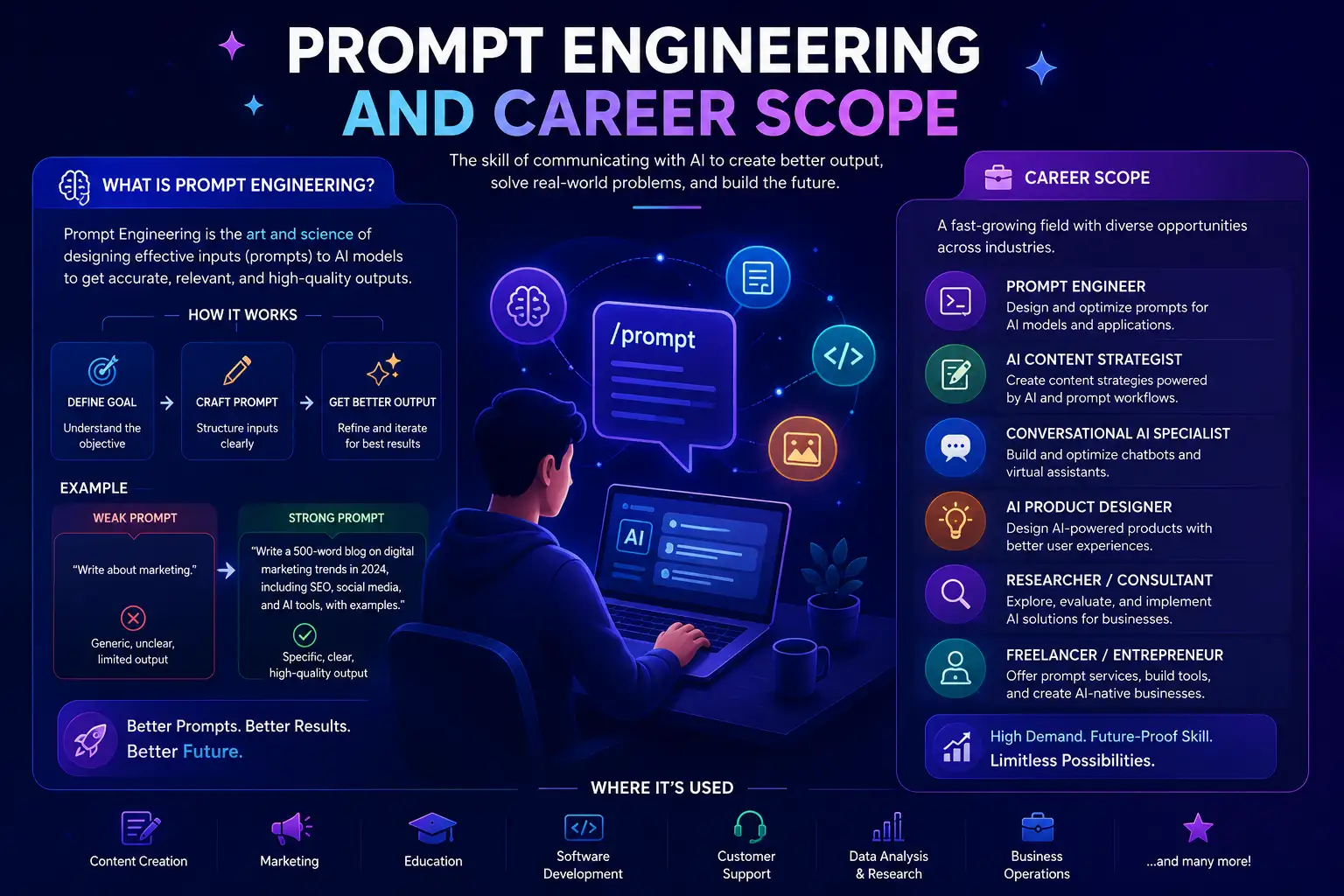
Prompt Engineering: The Skill That's Reshaping Careers in the Age of AI
"The quality of your output is determined by the quality of your input."
This has always been true in computing. With AI, it's become an art form.
What Is Prompt Engineering?
Prompt engineering is the practice of designing, refining, and optimizing the inputs — called prompts — given to large language models (LLMs) like GPT-4, Claude, or Gemini to produce accurate, relevant, and high-quality outputs.
Think of it as learning to speak fluently with an AI. The same question, asked two different ways, can produce wildly different results. A prompt engineer knows exactly how to phrase requests to get the best possible response — consistently.
But it's more than just asking good questions. Prompt engineering involves:
- Instruction design — Crafting clear, structured directives
- Context injection — Providing relevant background information
- Few-shot learning — Showing the model examples of desired outputs
- Chain-of-thought prompting — Guiding the model to reason step by step
- Constraint setting — Defining tone, format, length, and boundaries
- Iterative refinement — Testing, tweaking, and improving prompts systematically
Why Prompt Engineering Is More Than a Buzzword
When ChatGPT launched in late 2022, the world got its first mainstream glimpse of what LLMs could do. By 2023, companies were scrambling to integrate AI into their workflows. By 2024–2025, the reality had set in: AI is only as useful as the people who can direct it.
This is the gap prompt engineering fills.
A skilled prompt engineer can:
- Cut development time by generating accurate code, documentation, or test cases on the first try
- Boost content quality by producing drafts that require minimal editing
- Reduce hallucinations by structuring prompts that constrain model outputs to verified information
- Unlock complex reasoning by designing multi-step prompts that guide models through difficult problems
- Save costs by reducing the number of API calls needed to reach a satisfactory result
Core Techniques Every Prompt Engineer Should Know
1. Zero-Shot Prompting
Asking the model to perform a task with no examples:Summarize the following contract in plain English, highlighting key obligations and risks.2. Few-Shot Prompting
Providing 2–5 examples to set the pattern:Classify the sentiment:
"The product arrived early and works perfectly." → Positive
"It broke after one use." → Negative
"Delivery was okay but packaging was damaged." → ?3. Chain-of-Thought (CoT) Prompting
Instructing the model to think step by step before answering — dramatically improves accuracy on complex reasoning tasks:Solve this problem step by step before giving your final answer...4. Role Prompting
Assigning a persona to shape the tone and expertise of responses:You are a senior tax attorney with 20 years of experience in corporate law. Review the following clause...5. System Prompts & Meta-Instructions
In API contexts, system prompts define the model's behavior globally — setting rules, personas, and constraints that apply to every response in a session.6. Retrieval-Augmented Generation (RAG) Prompting
Combining retrieved documents with a prompt so the model answers from a specific knowledge base rather than its training data — critical for enterprise applications.The Career Landscape: Where Prompt Engineers Work
The career scope for prompt engineering is expansive and still evolving. Here's where professionals are finding opportunities:
🏢 Big Tech & AI Companies
Companies like Anthropic, OpenAI, Google DeepMind, Microsoft, and Meta actively hire prompt engineers to red-team models, build evaluation datasets, and develop internal AI tooling. Titles include:- AI Prompt Engineer
- LLM Quality Specialist
- AI Interaction Designer
💼 Enterprises Across Industries
Law firms, healthcare providers, financial institutions, and e-commerce giants are hiring prompt engineers to build internal AI workflows — automating everything from legal document review to customer support.🚀 Startups & AI-Native Companies
Early-stage AI startups need prompt engineers to build the core product experience — designing the conversational flows, evaluation pipelines, and prompt architectures that power their applications.🎓 Education & Research
Universities and research institutions are studying prompt engineering as a discipline, creating roles for researchers who publish on jailbreaks, alignment, model behavior, and evaluation methodology.🧑💻 Freelance & Consulting
Platforms like Upwork and Toptal have seen a surge in demand for freelance prompt engineers. Consultants who can audit and optimize a company's AI stack command significant hourly rates.Salary & Compensation: What Does It Pay?
As of 2025–2026, compensation for prompt engineering roles varies widely based on seniority, specialization, and geography:
| Role | Entry Level | Mid-Level | Senior |
|---|---|---|---|
| Prompt Engineer | $70K–$90K | $100K–$140K | $150K–$200K+ |
| AI/ML Prompt Researcher | $90K–$110K | $130K–$160K | $180K–$250K+ |
| AI Product Designer (Prompting Focus) | $80K–$100K | $120K–$150K | $160K–$220K+ |
| Freelance (per hour) | $40–$75/hr | $80–$150/hr | $150–$300/hr+ |
Top researchers at leading AI labs with deep expertise in alignment and evaluation can earn well above these ranges, with equity packages that rival senior software engineering roles.
Skills That Complement Prompt Engineering
Prompt engineering rarely exists in isolation. The most effective practitioners combine it with:
- Programming (Python) — For building automated prompt pipelines, evals, and integrations with the Anthropic/OpenAI APIs
- Linguistics & Cognitive Science — Understanding how language and reasoning work helps in designing more effective prompts
- Domain Expertise — A lawyer who can prompt well is far more valuable than a generalist; specialization multiplies your value
- Data Analysis — Evaluating prompt performance across large datasets requires analytical thinking
- UX/Product Thinking — Designing AI-powered user experiences requires understanding what makes a response genuinely useful
- Ethics & Safety — Knowledge of bias, hallucination, and model limitations is increasingly expected
How to Get Started: A Practical Roadmap
Month 1 — Build Foundations
- Experiment daily with Claude, ChatGPT, or Gemini; push the limits of what you can get them to do
- Study Anthropic's and OpenAI's official prompt engineering guides
- Learn basic Python to interact with LLM APIs directly
- Work through structured courses (DeepLearning.AI's Prompt Engineering for Developers is excellent)
- Study published research on chain-of-thought, RAG, and few-shot learning
- Build a personal project: a custom AI assistant, a content pipeline, or an automated research tool
- Pick a domain (legal, medical, finance, education, coding) and become the go-to prompt engineer for it
- Share your experiments on LinkedIn, Substack, or GitHub
- Contribute to open-source evaluation frameworks like EleutherAI's LM Evaluation Harness
- Apply for roles, pitch consulting projects, or launch a productized service
- Build a portfolio of prompts, systems, and documented case studies
- Network within AI communities (Hugging Face forums, AI Discord servers, local meetups)
The Debate: Is Prompt Engineering a Permanent Career?
Some argue that as models improve, the need for careful prompting will disappear — future AI will just know what you mean. This is worth taking seriously.
But here's the counterargument: complexity scales with capability. As AI gets more powerful, the use cases become more sophisticated, the stakes get higher, and the need for precision grows — not shrinks. The bar shifts upward, not away.
Additionally, prompt engineering is increasingly merging with AI engineering — a broader discipline involving fine-tuning, evaluation, RAG architectures, and agent design. The professionals who invest in prompt engineering today are building the mental models they'll need for that larger field tomorrow.
The skill may be renamed. The work will remain.
Final Thoughts
Prompt engineering sits at a rare intersection: accessible enough that anyone with curiosity and patience can start today, yet deep enough that true mastery takes years. It rewards people who love language, logic, and experimentation equally.
Whether you're a developer looking to add AI depth to your skill set, a domain expert wanting to leverage AI in your field, or a career-switcher eyeing the AI economy — prompt engineering offers a credible, high-value on-ramp.
The machines are powerful. The people who know how to direct them are more powerful still.